
Article
Julia Featured in Business Impact Magazine
We are pleased to share that Julia’s article, Demystifying the self-awareness debate, has been published in Business Impact magazine.

We are pleased to share that Julia’s article, Demystifying the self-awareness debate, has been published in Business Impact magazine.

Julia joins Gerry Murray on the Leading People podcast to explore why self awareness is far rarer than most leaders believe, and why it matters most in times of uncertainty.

When I took part in the ‘Highly Relational’ podcast with Robert Diggings he kindly introduced me as “the highly self-aware” Julia Carden! I quickly corrected him saying that I was still very much work in progress and based on my research findings I know that I have a considerably long way to go.

Julia recently joined the Influence & Impact for Leaders podcast to explore one of the most talked about, and most misunderstood, leadership skills: self awareness. In this episode, Julia shares insights from her PhD research, her coaching work with senior leaders, and her own ongoing development. The conversation looks at why self awareness is often overestimated, how blind spots show up in teams, and why feedback can feel challenging but essential.

One of the core-components of self-awareness is what is going on in our physiology i.e. our bodies. However, most of our work and lives is dominated by our heads and cognitive space, and I believe this has been exacerbated since COVID as we spend an increasing amount of time on-line, and when we are on zoom or teams we are just connecting with one another’s heads!
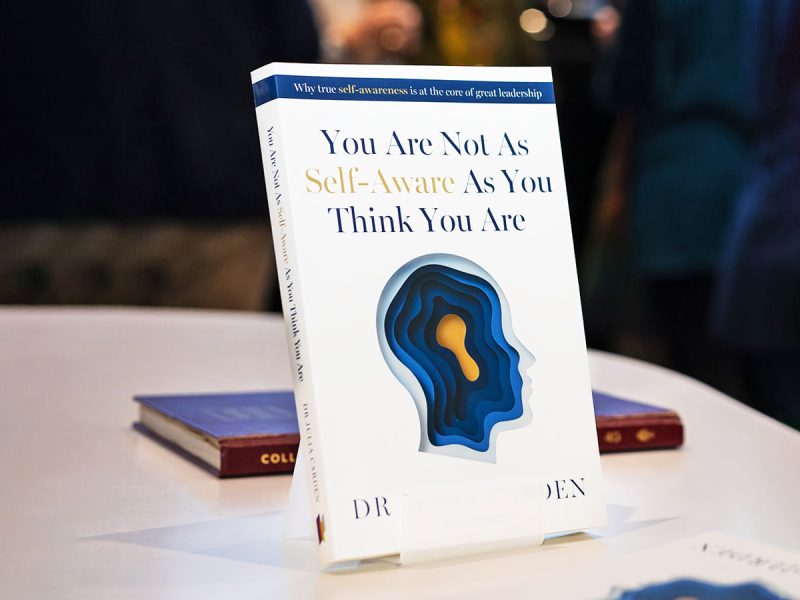
Julia’s new book, You Are Not As Self-Aware As You Think You Are, launched on 21 October 2025. Based on her PhD research and years of coaching experience, it explores self awareness in a clear and practical way. Watch the video below to hear Julia share the story behind the book.

Julia has joined host Nia Thomas for the 100th and final episode of the Knowing Self Knowing Others Podcast. This milestone conversation explores the meaning of self-awareness in leadership and coaching, drawing on Julia’s PhD research and her extensive career experience.

In leadership and coach development, in assessment centres and in competency frameworks the term self-awareness is frequently used, and personally I know it is a competency that I have strived to develop. It has become a popular ‘buzz’ word in management and leadership publications, with claims that it is linked to increased performance, emotional intelligence and effective leadership; and it is often perceived to be a critical component in leadership and career success.

Workplace coaching is a rapidly growing industry, and while there has been some research carried out to explore the effectiveness of coaching and to evaluate coaching outcomes, there has been very little research to underpin coach development and how coaches best develop coaching competence for workplace coaching.

It is proposed that it is critical that coaches are highly self-aware to be effective at facilitating the development of self-awareness in
their clients. Accordingly, self-awareness is included in the competency frameworks of the coaching professional bodies, yet
there is a lack of evidence supporting how coaches develop self-awareness.

Self-awareness is often seen as a critical component in leadership and career success, and has therefore become a feature in MBAs, leadership development, and management education. It has become a popular “buzzword” in management literature, yet when reviewing this literature, there appears to be no consistent definition of the construct.

We dive deep into the transformative concept of self-awareness and explore its profound impact on personal growth, leadership, and coaching. Join our host, Claudia Day, as she sits down with coach and academic Julia Carden. Julia shares her journey from leadership in the Royal Navy to her research and deep reflective exploration into self-awareness for coaches and leaders.

As an executive coach with a PhD in self-awareness and a background as a HR consultant, civil servant and Royal Navel Officer, Julia is perfectly placed to highlight why self-awareness allows us to become better leaders, team members and co-workers. Julia explains how self-awareness underpins every other form of self-understanding and how perspective and ego are part of what makes it so difficult to truly achieve.

I recently attended a day exploring ‘shame’ in coaching supervision. It was such a thought-provoking day, and it inevitably led to me connecting with my own shame. As Brene Brown highlights, shame, is something we all experience, and it is an intense feeling linked to not feeling good enough or worthy. I can relate to this big time! It is also about what we don’t like talking about and want to avoid confronting.

To many practicing coaches and coaching supervisors, it appears that there is common agreement that all coaches need to be self-aware to be effective and to develop coaching maturity. However, this is not uniformly represented by the professional coaching bodies as not all of them include coach self-awareness as a stand-alone core competency. Alongside this the evidence and academic literature lacks consistency in terms of providing evidence as to the importance of coach self-awareness, and many coach training programmes primarily focus on coaching skills e.g. questioning and listening or other core competencies.

I took part in the Highly Relational podcast earlier in the year and Robert (the podcast facilitator) asked me “what is the one thing you want people listening to this podcast to take away?” My response to this was “well, if you think you are self-aware you probably aren’t and that developing it is a life-times work”…

In leadership and coach development, in assessment centres and in competency frameworks the term self-awareness is frequently used, and personally I know it is a competency that I have strived to develop. It has become a popular ‘buzz’ word in management and leadership publications, with claims that is linked to increased performance, emotional intelligence and effective leadership; and it is often perceived to be a critical component in leadership and career success.

In this episode, Holly and I are joined by Dr Julia Carden and we discuss Julia’s research paper that seeks to understand how we should define self-awareness.

As coaches, coach trainers and coach supervisors we often talk about self-awareness and why it is important to ourselves and our clients, and I have already posted on what self-awareness is and why it is important to us as coaches.
Self-awareness is the route through to self-connection, from which you can project a level of inner peace and contentment.
Find out moreIf you are up for an intensive deep dive on the journey to develop self-awareness 1-2-1 coaching is the way to go.
Find out moreMy original PhD research underpins my thinking in this space. Read my published papers and hear me talking on podcasts.
Find out more


